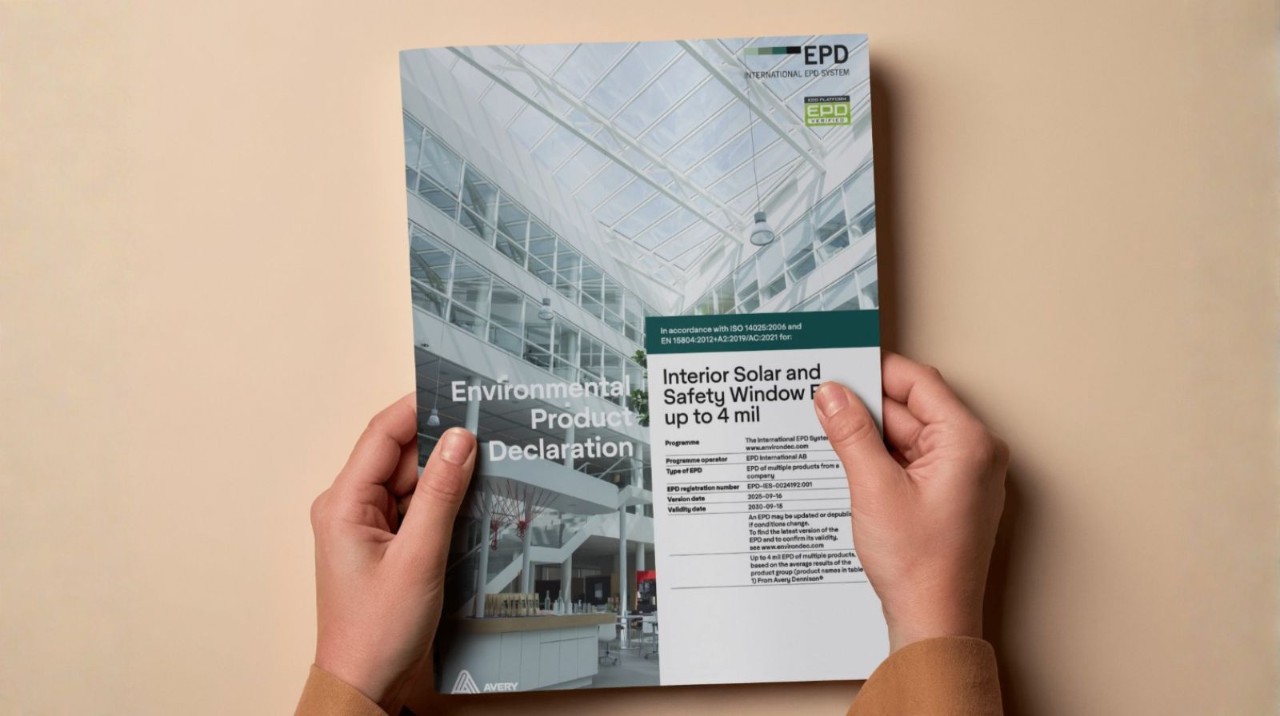
Introducing Our First EPD for Solar Control Interior Window Films

Our first Environmental Product Declaration (EPD) report has now been published!  
 

This EPD summarizes the Lifecycle Assessment (LCA) results, including the carbon footprint, of a total of 24 products within our range of Architectural Interior Window Films that have a thickness of up to 4 mil.

An EPD is a verified and registered Type III environmental declaration, created in accordance with the ISO 14025:2006 standard, ensuring transparent and verifiable information on a product’s environmental impact. 
 

Net Positive Carbon


Our solar control window films are designed to significantly reduce heat gain through the glazing, helping to maintain cooler and more comfortable indoor environments. This allows for a lower demand on air-conditioning systems, leading to reduced energy consumption and improved overall carbon footprint throughout the building’s lifecycle. 

To quantify the potential energy savings from installing our interior window films, we utilized eQUEST, a software that performs detailed comparative analysis and energy use simulation for building designs and technologies. eQUEST calculates a building's overall energy consumption based on parameters such as the building type, dimensions, glazing, geographical location (which links to climate data), and the cooling/heating systems.

The calculated annual energy savings were then converted to carbon footprint estimation (in kg CO2), in accordance with published energy information administration data specific to each location. 

For example, applying R Silver 20i to a 6 mm single pane in Europe, results in an average saving of 21 kgCO2/sqm per year.

When the energy savings are compared against the product’s own carbon footprint, estimated to be 1.35 kg CO² eq / sqm (based on our LCA for R Silver 20i), the results show that our interior window films achieve a net positive carbon in less than a year and in some cases even less than a month!

This means that more carbon is removed from the atmosphere than emitted during the product’s life cycle.


What’s Next? 

This is just the first step! Our next goal is to publish a complete series of EPDs for our entire Architectural Window Film portfolio. So, keep a look out as we continue our efforts to provide transparency and support data-driven decision making!


For more information about our sustainability commitment, you can visit our sustainability page on our website and take a look at our Sustainability FAQ page.