
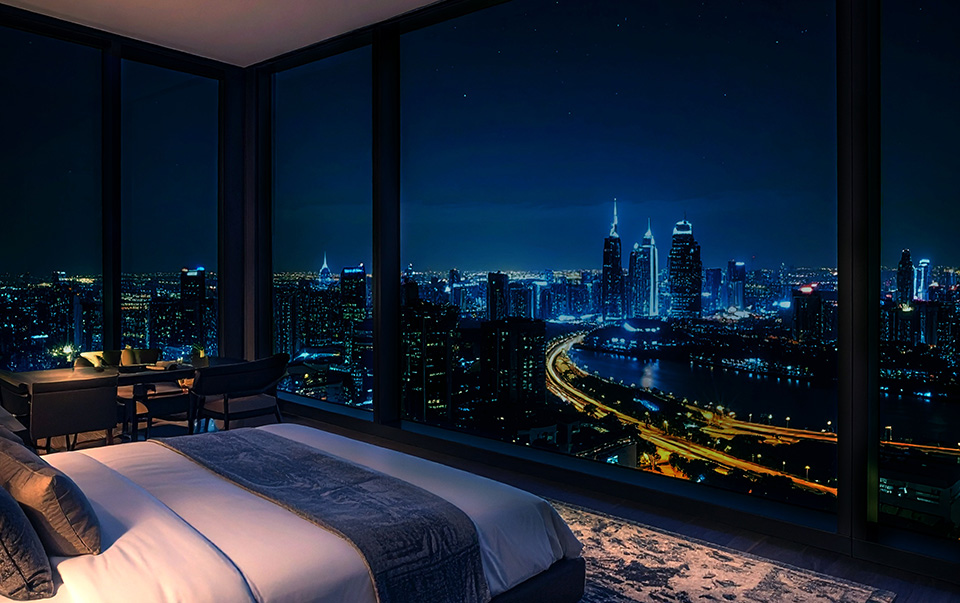
Most commercial buildings fitted with reflective window film share a common frustration. By day, the mirror-like exterior keeps interiors private and comfortable. By night, the dynamic flips entirely. Interior lighting becomes brighter than the outside environment, turning those same windows into a clear view straight into the building. Occupants lose privacy precisely when they need it most.
This is the night-view dilemma—and it's a persistent challenge for facility managers and building owners who've invested in solar control without accounting for after-dark performance.
What causes the night-view dilemma in commercial buildings?
The issue comes down to light differential. Standard reflective window films work by bouncing exterior daylight away from the glass. When ambient outdoor light is stronger than interior lighting, the film's exterior reflectance masks the interior. Once the sun sets, that balance shifts. Interior lights now dominate, and the film's reflective properties work against the occupant—creating a fishbowl effect from the outside looking in.
For offices, healthcare facilities, and commercial spaces operating into the evening, this is more than an inconvenience. It raises legitimate concerns around occupant privacy, security, and the professional appearance of the building.
How do dual-reflective architectural films solve this problem?
Avery Dennison's dual-reflective architectural films are engineered with two distinct functional layers working in tandem:
- The outer layer carries a bold silver reflective finish. During daylight hours, this layer deflects solar radiation, reduces glare, and maintains strong daytime privacy from the street or adjacent buildings.
- The inner layer uses a warm neutral grey tone with deliberately low interior reflectance. This prevents the interior from creating a mirror surface when lights are on, preserving both outward visibility and privacy after dark.
The result is a performance window film that doesn't force building managers to choose between daytime solar control and after-hours privacy. Both are delivered by design.
What does the DR Grey X Series offer for commercial applications?
The DR Grey X Series represents Avery Dennison's flagship dual-reflective exterior architectural film range, developed for commercial and residential retrofit glazing projects. Key performance specifications include:
- Glare reduction of up to 92% (DR Grey XTRM 10 variant), significantly improving occupant comfort and productivity in sun-exposed spaces.
- 99%+ UV block across the full DR Grey X range, protecting interior furnishings, flooring, and equipment from sun-related fading and damage.
- Total Solar Energy Rejected (TSER) of up to 85% on double-pane glass (DR Grey 10X), substantially reducing the load on HVAC systems and cutting associated cooling costs.
- Selective Infrared Reduction (SIRR) of up to 93%, targeting the heat-producing portion of the solar spectrum without compromising visible light quality.
Available across three visible light transmission (VLT) levels—10X (8% VLT), 20X (19% VLT), and 35X (36% VLT)—the DR Grey X Series can be matched to specific building orientations, glass specifications, and privacy requirements.
Is dual-reflective window film suitable for existing commercial buildings?
One of the practical strengths of Avery Dennison's dual-reflective architectural film range is that it functions as a non-disruptive retrofit solution. There's no need for full window replacement or structural modification. The film applies directly to existing glazing systems, updating the exterior appearance of the building while delivering immediate solar performance gains.
This makes it particularly suited to:
- Commercial office buildings managing energy efficiency audits or sustainability targets.
- Facilities undergoing renovation that want to modernise aesthetics without replacing glazing.
- Buildings in urban, high-sun-exposure environments where thermal comfort and glare are pressing operational concerns.
The exterior's clean, silver reflective finish also upgrades a building's visual profile—a meaningful benefit for commercial landlords and facility managers focused on both performance and kerb appeal.
Frequently Asked Questions
Q1. What is the night-view dilemma with window film?
The night-view dilemma refers to a privacy failure common with standard reflective window films. During the day, the film's exterior reflectance masks the interior from outside view. At night, interior lighting becomes brighter than the outdoor environment, reversing the effect and making the interior clearly visible from outside.
Q2. How does dual-reflective window film maintain privacy at night?
Dual-reflective architectural films use two distinct layers: a highly reflective outer layer for daytime solar control and privacy, and a low-reflectivity inner layer that prevents interior light from creating a mirror effect after dark. This design maintains occupant privacy and outward visibility both day and night.
Q3. What glare and UV performance does the Avery Dennison DR Grey X Series offer?
The DR Grey X Series reduces glare by up to 92% (DR Grey XTRM 10 variant) and blocks 99%+ of UV radiation across all variants. The DR Grey 10X variant rejects up to 88% of total solar energy on double-pane glass, according to Avery Dennison's published optical and solar performance data.
Q4. Is the DR Grey X Series suitable for commercial retrofit projects?
Yes. Avery Dennison's dual-reflective exterior films are specifically designed as a non-disruptive retrofit solution for existing commercial glazing systems. Installation does not require window replacement, making it a cost-effective option for buildings undergoing energy efficiency upgrades or facade modernisation.
Q5. What VLT options are available in the DR Grey X Series?
The DR Grey X Series is available in three visible light transmission levels: DR Grey 10X (8% VLT), DR Grey 20X (19% VLT), and DR Grey 35X (36% VLT). Each variant offers the same dual-layer privacy and solar control construction, with different levels of light transmission to suit varying building orientations and occupant preferences.